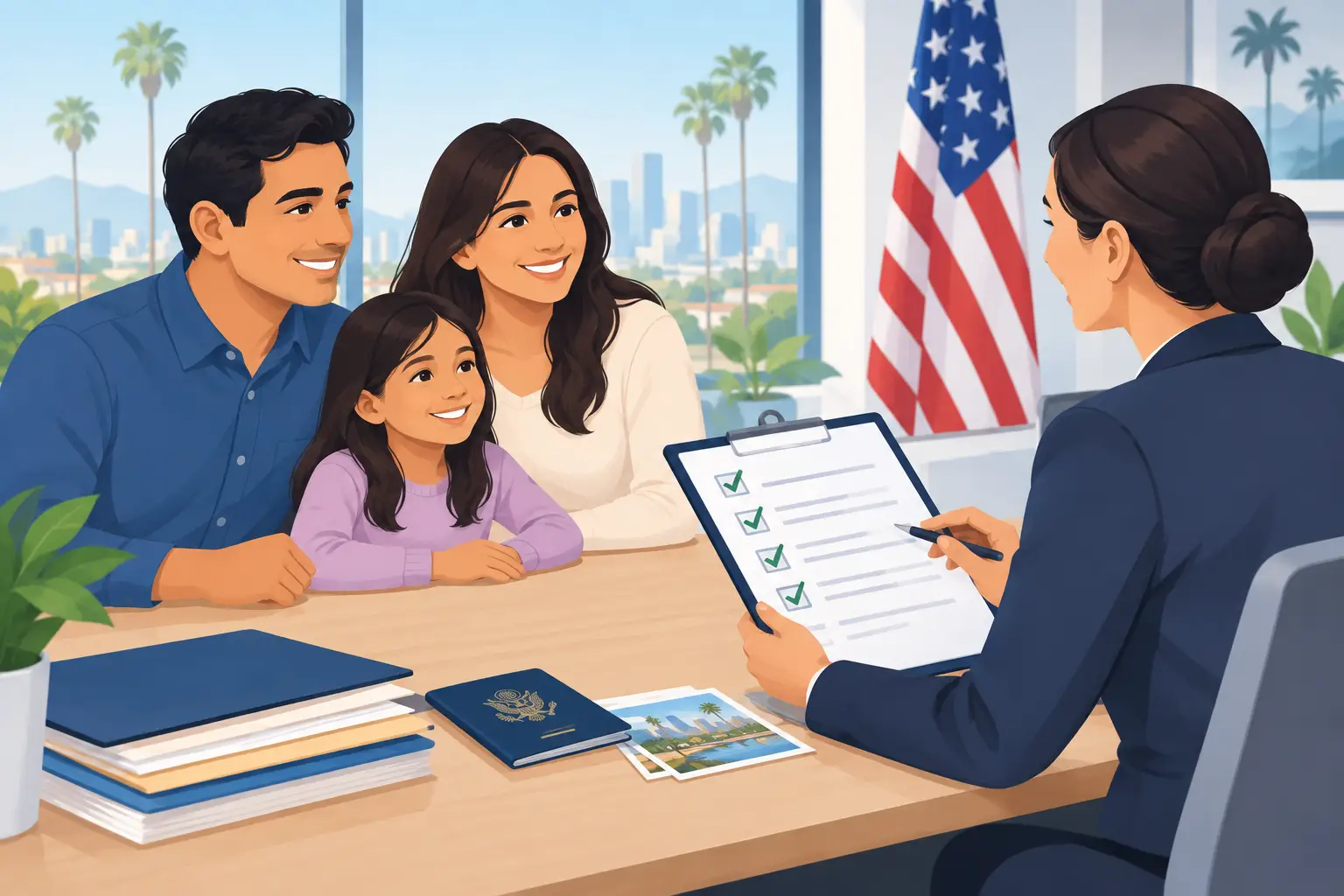
A green card interview can feel like the last big hurdle after months of forms, notices, appointments, and waiting. The best green card interview document checklist is not simply a stack of papers. It is a clear, organized file that helps you bring the documents requested for your specific case and answer questions with confidence.
Every family’s situation is different. A marriage-based adjustment case may require current evidence of a shared life, while an employment-based or family-preference case may call for a different set of updates. Your interview notice is the starting point. Read it carefully, then use the checklist below to organize what applies to you.
Start With Your Interview Notice
Bring the original interview appointment notice. It confirms the date, time, location, and case details, and it may include instructions unique to your appointment. Do not rely only on a screenshot in your phone. Put a printed copy at the front of your folder.
Review the notice line by line at least a week before the interview. If it asks for specific evidence, treats that request as a priority over any general online checklist. Notices can ask for updated documents, originals of civil records, proof related to a petitioner or sponsor, or other information connected to the pending application.
If you have received any notices after filing, bring those too. This may include receipt notices, biometrics notices, requests for evidence, or copies of documents you submitted in response. Keeping the paper trail together makes it easier to locate information if a question comes up.
Green Card Interview Document Checklist: Core Records
Start with documents that establish identity, immigration history, and the application you are attending. Bring originals when available, along with clear copies for your own records. USCIS may review original documents and return them to you.
Your core folder will commonly include:
- Your interview appointment notice and photo identification, such as a valid passport, state ID, or driver’s license.
- Your current passport and any expired passports that contain visas, entry stamps, or other immigration records relevant to your case.
- Copies of the forms filed in your case, including the adjustment application and supporting forms, plus all receipt notices.
- Your I-94 travel record, if applicable, and any employment authorization documents, advance parole documents, or prior immigration notices.
- Original civil documents, such as birth certificates, marriage certificates, divorce judgments, death certificates, and name-change records, when they apply to your case.
For documents issued in a language other than English, bring the English translation and required certification along with the original-language document. Names, dates, and places should match across your records whenever possible. If a name is spelled differently on two documents, bring the records that explain the difference, such as a marriage certificate, court order, or other official document.
Bring Evidence That Is Current, Not Just Old
One common mistake is bringing only the documents submitted months or years ago. An interview often focuses on whether the information in the application remains accurate today. Think about what has changed since filing.
You may need updated pay stubs, an employer letter, recent tax documents, a current lease, or proof of a new address. If you have changed jobs, had a child, moved, traveled outside the United States, or experienced another significant change, collect documents that accurately reflect your current circumstances.
Do not alter, create, or exaggerate evidence. A smaller folder of genuine, orderly documents is more useful than a thick binder filled with unrelated papers. Bring what is requested and what truthfully supports the information in your application.
If Your Case Is Marriage-Based
For a marriage-based green card interview, both spouses should be prepared to show that they share a real life together. The strongest evidence is often practical and current rather than overly staged. Bring documents from different parts of your life and from different dates.
Useful items may include a joint lease or mortgage, joint bank statements, insurance policies, utility bills, jointly filed tax returns, vehicle titles, beneficiary designations, records related to children, and photos from family events or ordinary activities. If you bring photos, choose a manageable selection and organize them by date or event. A few pages that clearly show your relationship over time are usually easier to review than hundreds of loose pictures.
The right evidence depends on your household. Some couples keep finances separate, live with relatives, or have only recently moved in together. In those situations, bring truthful documents that reflect how you actually share responsibilities and make daily decisions. The goal is accuracy, not a perfect-looking file.
If Your Case Needs Financial Sponsorship Documents
Some green card cases require financial sponsorship materials. If your interview notice requests updated financial information, bring the sponsor’s most recent federal tax return or tax transcript, recent W-2s or 1099s if applicable, pay stubs, and an employment verification letter when available.
If a joint sponsor is involved, keep that person’s documents in a separate labeled section. Do not mix them with the petitioner’s records. Clear labels can save time and reduce stress when an officer asks for a particular item.
If You Are Interviewing Through a U.S. Consulate
A consular immigrant visa interview has its own instructions. Applicants should follow the appointment letter and the consulate’s requirements closely. Common items can include the appointment confirmation, passport, civil documents, financial sponsorship records when required, photographs, and medical examination materials handled according to the medical provider’s instructions.
Some consular appointments require original records that were previously uploaded, while others have country-specific document requirements. Check the instructions for the specific post where the interview will occur. Do not assume an adjustment-of-status checklist is interchangeable with a consular-processing checklist.
Organize Your Folder So You Can Find Everything
A simple accordion folder or binder with tabs can make a difficult morning feel much more manageable. Place your interview notice first, followed by identification and passports, application copies and notices, civil records, financial documents, and case-specific evidence.
Use labels that make sense to you: “Passports,” “Marriage Documents,” “Joint Finances,” “Taxes,” and “Work Records.” Keep originals and copies together when practical, but separate them with a paper clip or divider so you can tell them apart quickly. Avoid staples, oversized binders, and loose papers that can be misplaced.
Make one complete copy set for your personal records before the interview. You may not need to hand over every page, but having copies allows you to keep track of what was brought or requested. It is also helpful to take a photo or scan of your organized file for your own reference.
Prepare for Questions Without Memorizing a Script
The interview is not a test of perfect memory. It is a chance to confirm the information in the application and address questions about your eligibility and supporting documents. Review your filed forms before the appointment so dates, addresses, travel history, employment information, and family details are familiar.
If you do not understand a question, ask for it to be repeated or clarified. Answer honestly and directly. Guessing can create confusion, especially about dates or prior addresses. If a document is missing or an answer requires additional information, stay calm and be clear about what you have available.
Arrive with enough time to park, pass through security, and check in. Follow the location’s rules about electronics, food, visitors, and photography. These details may seem small, but they can affect an already stressful day.
Get Help Before the Appointment, Not the Night Before
Document preparation support can be especially helpful when paperwork is spread across several years, documents are in English and Spanish, or a family needs a clean system for organizing a large file. Hemet Document Prep Center helps clients prepare forms and organize documents at the client’s direction, with bilingual English-Spanish assistance and virtual consultations available.
A prepared folder cannot predict every question, and no checklist can replace the instructions in your notice. Still, giving yourself time to gather current, truthful, well-organized documents is one practical way to walk into the appointment feeling more prepared and less overwhelmed.
Hemet Document Prep Center is not a law firm. We are not attorneys and cannot provide legal advice or legal representation. We provide legal document preparation services at the client’s direction