A birth certificate in Spanish may look straightforward, but a missing translator certification, an omitted stamp, or a translated page that does not match the original can create avoidable questions in an immigration filing. This immigration document translation requirements guide explains what families should gather, what a complete translation generally includes, and how careful organization can make the filing process less stressful.
When an English Translation Is Needed
For many immigration filings, documents written in a language other than English must be submitted with a full English translation. This often includes civil records such as birth certificates, marriage certificates, divorce decrees, police clearances, school records, medical records, court documents, and prior immigration paperwork.
The key word is full. A translation should not leave out seals, stamps, handwritten notes, marginal comments, entries marked “N/A,” or information on the back of a document. Even when a detail appears unimportant, it may be part of the record the reviewing agency needs to see.
A Spanish-language document does not always need to be reissued before it can be translated. However, the filing instructions for the specific application may call for a certified copy, an original document at an interview, or other supporting records. Translation and document authenticity are separate requirements, so one does not replace the other.
What a Certified Translation Usually Includes
A common source of confusion is the phrase “certified translation.” It does not necessarily mean the translation has been notarized or issued by a government office. In many immigration matters, the translation is accompanied by a signed certification from the translator stating that the translation is complete and accurate and that the translator is competent to translate from the original language into English.
The certification should generally identify the language translated and include the translator’s name, signature, date, and contact information. The statement should be attached to the English translation, not provided separately without a clear connection to the document.
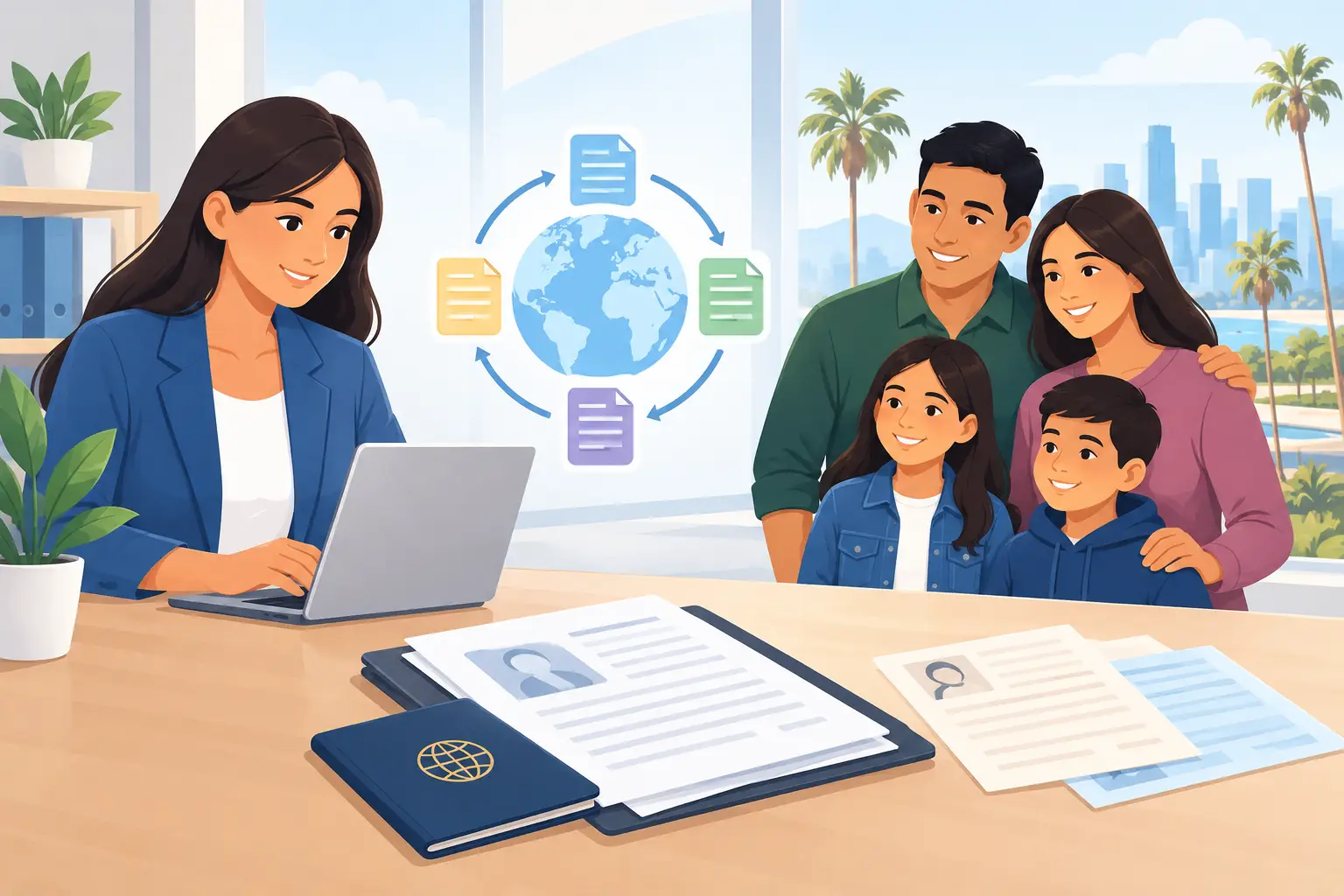
A complete packet is commonly organized in this order: a readable copy of the original-language document, the full English translation, and the translator’s certification. Keeping those pages together reduces the chance that a reviewer sees a translation without knowing what document it belongs to.
Do not confuse certification with notarization
Notarization and translation certification are different. A notary verifies the identity of the person signing a document; a notary does not confirm that the translation itself is accurate. Some agencies, consulates, or foreign authorities may request notarization or have their own format rules, but it should not be assumed that notarization is automatically required for every immigration filing.
The application instructions and any request from the reviewing agency should guide the final package. If an instruction specifically asks for a notarized translation, certified copy, or original record, follow that instruction closely.
Immigration Document Translation Requirements: Common Mistakes
Translation problems are often administrative, not dramatic. A name may be spelled differently in two records, a date may be converted incorrectly, or a translator may summarize a document instead of translating every entry. These small issues can slow down a case because the submitted records no longer clearly support the information listed on the forms.
Names deserve special attention. Many records from Latin America use two surnames, compound surnames, accents, or different name order than U.S. forms. The translation should reflect the document accurately. If a person has used a different spelling or name variation, the filing may need supporting documentation that connects the records. Do not change a translated name simply to make it look more familiar in English.
Dates also require care. A date written as 04/07/1998 may mean April 7 or July 4 depending on the country’s format. A quality translation should make the intended date clear rather than creating a new ambiguity.
Other frequent issues include:
- Translating only the main text while omitting seals, stamps, and handwritten annotations.
- Submitting a blurry scan that makes the original document impossible to read.
- Using a certification statement that lacks a signature, date, or translator information.
- Separating translated pages from the original-language record.
- Mixing documents for different family members in the same file without clear labels.
These errors are preventable when documents are reviewed as a complete packet before forms are assembled.
How to Prepare Your Documents Before Translation
Start by making a document inventory. Write down each person’s name, the document type, country of issue, issue date, language, and whether you have a clear copy. This is especially helpful for family-based immigration matters, citizenship applications, renewals, or cases involving records from more than one country.
Next, compare every record with the names, dates, places of birth, and marital history listed on the forms. If one document shows “Maria Elena Lopez Garcia” and another shows “Maria Lopez,” flag the difference early. It may be completely explainable, but it should not be discovered after documents have already been assembled for filing.
Use clear, complete scans or copies. Cropped images, dark photographs, and cut-off corners can make a valid record harder to review. Include both sides when there is printing, a seal, a notation, or an identification number on the back. Keep the original document in a safe place unless instructions specifically require it to be mailed or presented.
For records that are difficult to read, damaged, or incomplete, obtaining a cleaner copy from the issuing authority may be more useful than trying to work around the problem. A polished translation cannot correct an unreadable original.
Keep family records separated and labeled
When a household is gathering documents for a spouse, parent, child, or petitioner, it is easy to combine papers accidentally. Use simple labels such as “Applicant – Birth Certificate” and “Petitioner – Marriage Certificate.” Clear organization helps ensure that each translation is paired with the correct person and the correct form.
If documents are in both English and another language, do not assume the English portions eliminate the need for translation. Whether translation is needed depends on the document as a whole and the filing instructions. A document with a bilingual heading but important entries in Spanish may still need a complete English translation.
Choosing a Practical Translation Process
The least expensive option is not always the best value if it produces an incomplete translation or no usable certification. A family member may understand both languages well, but the person preparing the translation should be able to accurately translate the document and provide the required certification. The translation should read clearly in English while staying faithful to the original record.
Machine translation can be useful for helping a family understand what a document says, but it is not a substitute for a properly prepared translation and certification. Automated tools can miss legal terminology, handwriting, regional abbreviations, and formatting details found in civil records.
For Southern California families, bilingual document preparation support can make the process easier by helping organize records, identify documents that need English translations, and keep the final packet in a logical order. Hemet Document Prep Center assists clients with practical document preparation and bilingual English-Spanish support at the client’s direction.
A Final Check Before Filing
Before submitting anything, review the packet page by page. Confirm that every foreign-language document has its matching English translation, each translation includes a signed certification, and all names and dates are consistent with the forms. Then review the instructions for the particular application one more time, because document requirements can vary by filing type and may change.
Careful preparation cannot decide an immigration case, but it can prevent your paperwork from creating unnecessary confusion. When documents carry your family history, treating every page with care is one of the most practical steps you can take.
Hemet Document Prep Center is not a law firm. We are not attorneys and cannot provide legal advice or legal representation. We provide legal document preparation services at the client’s direction